The rhythm behind the name
The bulería: flamenco's party rhythm
What a bulería is, how its twelve-beat cycle works, why it so often closes a flamenco night and what to listen for when the tempo lifts.
See open evenings and book ↗Quick answer
The bulería is a fast flamenco form built on a twelve-beat cycle, with accents on beats 3, 6, 8, 10 and 12. Its roots lie with the Calé Romani community of Jerez, in the 1800s, and a gathering of flamenco often finishes on one, with vigorous dancing and handclaps. It allows more improvisation than most palos, which is why it feels like a party.
What a bulería is
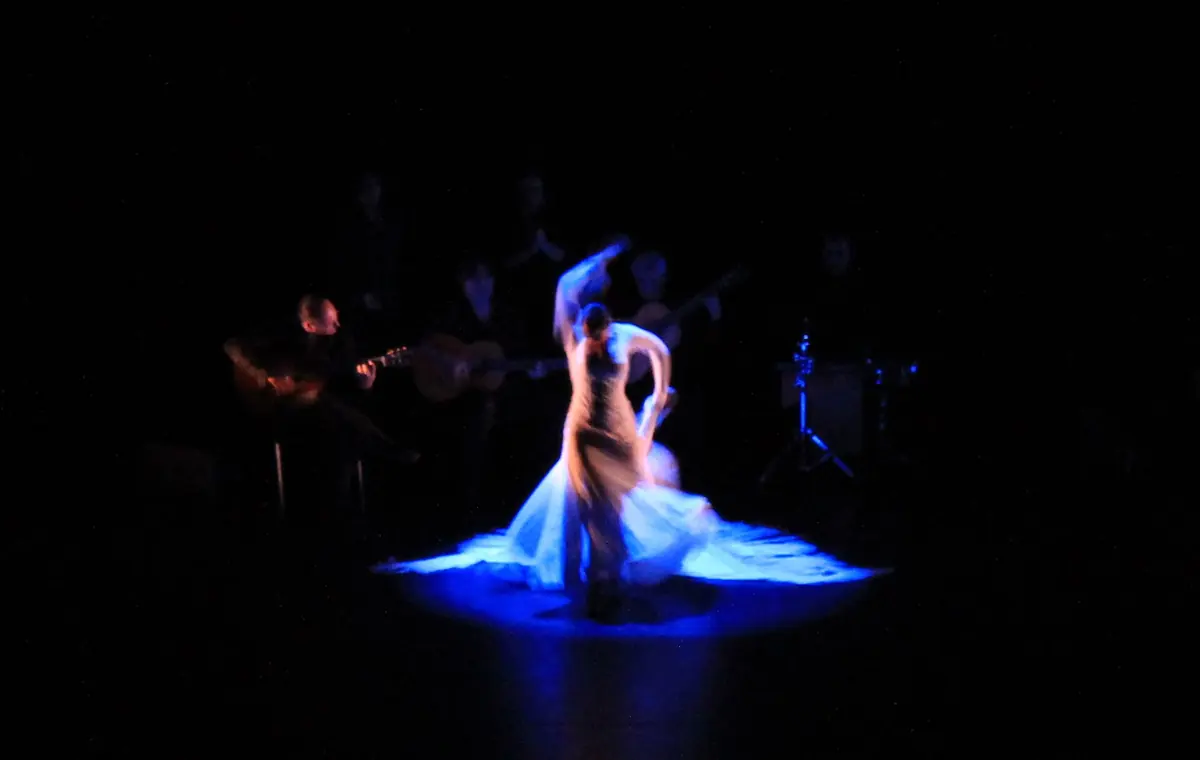
The bulería is a fast flamenco rhythm, and Wikipedia calls it the emblematic palo of flamenco. Few palos are as popular or as dramatic. It came out of the Calé Romani community of Jerez in the 19th century, at first as a brisk, cheerful finish to the soleares and related palos, and it now often closes a whole flamenco gathering, with vigorous dancing and tapping. Because it began as an upbeat ending, hearing one often signals that the evening is turning from the grave to the festive.
Counting twelve
The bulería runs on a twelve-beat cycle. Today it is most often played with accents on the third, sixth, eighth, tenth and twelfth beats, and the cycle begins on beat twelve, so the accent comes first. The palmas are played in groups of six, which sets up counter-rhythms inside the twelve, and dancers usually count in six rather than twelve. Heard another way, it is a bar of six-eight followed by a bar of three-four.
Why it sounds like a party
Speed and freedom make the difference. Wikipedia describes the bulería as the form that allows the most improvisation, with the rhythm central to everything. Performers need speed, agility and firm control, and dancers use intricate footwork with toe, heel and ball of the foot. Where slower palos let a singer hold a note, the bulería keeps pushing forward, which is why it is the natural place for a dancer to show off and for the room to join the clapping. A study of more than two thousand flamenco lyrics, summarised by Wikipedia, also found bulerías covering the widest range of subjects.
Where the name comes from
The name is traced to the Spanish verb burlar, to mock, or to the noun bullería, which means racket, shouting or din. Either fits the sound of a bulería in full flow, when clapping, calls and stamping overlap. The tablao in Valencia that this site follows shares its name with the form, and its own show page lists bulerías among the palos it presents, alongside the older and graver tonás, seguiriyas and soleares and the lively tangos.
Regional styles and speeds
Bulerías are sometimes divided into bulerías al golpe, which are slower, and bulerías ligadas, which are frantic. Regional styles come from Lebrija, Jerez, Cádiz and Utrera, and Jerez is the most common. In some regions, such as Jerez, the rhythm stays in a simpler six-count cycle and uses the twelve only to resolve a phrase. That is why two bulerías can feel so different even when both are danced at speed.
Singing and playing a bulería
When sung, a bulería has three or four lines of eight syllables each. The guitarist always begins on beat twelve, so the accent is heard first, and a typical strumming pattern uses only two chords, accented by taps on the guitar. Traditional players use chords from the Andalusian cadence, the chord sequence Wikipedia describes as typical of flamenco, while modern players influenced by jazz use more varied harmony. All of it sits under the clapping.
Listening for it in a tablao
When the guitar speeds up and the claps start to overlap, you are probably hearing a bulería. Listen for the first beat of the cycle landing on the accent, then for the singer trading verses with the dancer. You do not need to count. Watch the room: when the cast ends the evening on a bulería, the clapping tends to spread from the performers to the tables.
Read next: How to watch a flamenco show
Frequently asked questions
What does bulería mean?
The name is traced to burlar, to mock, or to bullería, racket or din. Both suit a fast, noisy form.
How fast is a bulería?
Fast. Wikipedia gives a typical range of 195 to 240 beats per minute, though regional styles vary and slower versions exist.
Why does a flamenco night often end on a bulería?
It is a festive, danceable form that often ends any flamenco gathering, and it allows the most improvisation.
Does the tablao take its name from the rhythm?
It shares the name. The venue's show page lists bulerías among the palos it presents.
Sources